


During a recent client visit, our partners communicated with engineers from Gewiss, who proudly stated, "Automatic reclose for leakage protection was first developed by Gewiss in the low-voltage sector." Coincidentally, the Matismart team was also planning a comprehensive solution using CIRCUTOR leakage modules + remote control for another client at that time. By comparing and analyzing these two systems, the value and inevitability of automatic reclose become much clearer.
From the perspective of electrical automation professionals, automatic reclose has long been considered the "signature technology" of high-voltage (HV) power grids, specifically designed to handle large, transient faults such as lightning strikes, pollution flashovers, and momentary short circuits.
So, when did automatic reclose quietly "descend" into low-voltage power distribution systems? Why is it that when we open the catalogue of any European brand of RCD/MCB today, we can see a small "Auto Reclose Module" right next to it? More importantly, why has it suddenly become the "standard configuration" for low-voltage power distribution? Why has it become indispensable in buildings, industry, data centers, pump rooms, and even household cold chain equipment?
Matismart believes that the answer to these questions cannot be simply summarized as "convenience for the user." Behind it lies a complete and profound story involving: the history of power protection technology development + the evolution of safety standards + market demand drivers. Today, we will systematically explain the inevitability of low-voltage automatic reclose based on the timeline and technical background, hoping to help everyone gain a complete understanding of this technology, from its high-voltage origins to its current status.
01 | How Was Automatic Reclose Born in High-Voltage Power Grids? (The Logical Origin)
The "ancestor" of low-voltage automatic reclose is, without a doubt, the high-voltage (HV) power grid. From the 1950s to the 1980s, global power grids faced a major challenge: transmission lines frequently tripped due to transient faults (lightning strikes, pollution flashovers, animals touching lines, etc.), causing momentary city-wide blackouts.
The common feature of these faults is that the fault duration is short, the line body itself is not permanently damaged, but the protective device trips. If personnel had to manually travel tens of kilometers to manually reclose the circuit every time, the reliability of the power grid would be extremely poor. In high-voltage systems, relay protection must satisfy the "Iron Triangle Principle": safety, reliability, and continuity.
Regarding the guarantee of continuity, the core technical means is automatic reclose. Its logical essence lies in distinguishing between transient faults and permanent faults.
- If it is a transient fault (such as a brief brush by a tree branch), the fault disappears after power is cut → the system attempts to reclose → power is restored.
- If it is a permanent fault (such as line insulation breakdown), the reclose attempt fails → the system locks out, waiting for repair.
We can clearly see that the operation process of high-voltage automatic reclose—trip, wait, reclose, try again, lock out—is completely consistent with the process used today on low-voltage automatic reclose modules.
02 | Why Did Automatic Reclose "Descend" from High Voltage to Low Voltage?
For a long time after the birth of HV automatic reclose, low-voltage (LV) distribution systems did not consider it a critical necessity. It wasn't until after the 1990s that LV systems began to face a series of "combination-punch" issues that were similar to, and sometimes more concealed than, HV transient faults.
🟦 The First Blow: Mass Adoption of Variable Frequency Drives (VFDs) → Nuisance Tripping of Residual Current Devices (RCDs)
As VFDs were widely adopted in industry (pump stations, fans, HVAC), they generated high-frequency leakage, capacitive leakage from EMC filters, and harmonic leakage. Traditional RCDs, designed for 50Hz sine waves, often overreacted to these complex "non-power-frequency pulses," leading to a large number of nuisance and false trips.
🟦 The Second Blow: Moisture, Condensation, and Water Vapor - "Transient Leakage" in LV Systems
In environments like basement pump rooms, cold storage facilities, and coastal buildings, leakage is no longer due to "equipment breakdown" but rather "environmental moisture." This type of leakage is temporary: moist in the morning → fault disappears after drying out at noon. Without automatic reclose, this can lead to thawing in cold storage or water stoppage in pump rooms, causing production and operational interruptions.
🟦 The Third Blow: Complete Electrification of Household Loads → RCD Sensitivity Challenge
All modern household appliances (air conditioners, refrigerators, and computers) contain EMC filter capacitors, which produce inherent capacitive leakage current. Combined with rain-day moisture or startup surges, the RCD is highly prone to tripping due to a "momentary surge in leakage current." The majority of these trips are not due to equipment failure but because the system is "too sensitive."
The situations encountered by low-voltage distribution are essentially the same as high-voltage transient faults: whether it's a lightning strike in HV or moisture in LV, an automatic retry mechanism is needed to ensure continuity of the power supply. This is the fundamental reason for the birth of automatic reclose for leakage protection in low-voltage distribution.
03 | Which Company First Brought "Automatic Reclose" to Low Voltage?
The technological trend of low-voltage automatic reclose was first jointly driven by Italy and Spain, with Gewiss and Circutor being among the earliest brands to commercialize it.
🔹Gewiss (Italy): Pioneer in the Residential Sector
Italy is one of the first countries globally to mandate the installation of RCDs (Residual Current Devices) in residences. From the 1980s onwards, RCDs became an almost "standard feature" in Italian households. The more RCDs were installed, the sooner the problem of nuisance tripping was exposed. Specifically, issues arose with:
- Variable frequency air conditioners
- Washing machines
- Electric water heaters
- Small pumps
- Freezers
- Humid coastal environments
This resulted in Italian users frequently experiencing unexplained tripping. Therefore, Italian manufacturers began developing auxiliary logic for "automatic restoration." It was against this background that Gewiss first launched the Restart series:
- A small box attached behind the RCD
- Automatically detects leakage
- Automatically recloses the circuit
- If unsuccessful, it locks out
- Supports an "Autotest" function
Its release timeline was indeed earlier than other manufacturers (around 1999–2002). This is why many Italian engineers today will say, "We invented automatic reclose." From the perspective of the "residential low-voltage" sector, that statement holds some truth.
🔹Circutor (Spain): Professional Industrial Solutions
Spain (Circutor) launched an industrial-grade solution almost at the same time.
While Italy focused on residential and domestic applications, Circutor in Spain focused on industrial and professional markets. Around the year 2000, Circutor launched:
- RGU-10 (External Zero-Sequence Current Transformer)
- WRU-10 (Internal Current Transformer)
- RAL (with Automatic Reclose)
- MT (Reclose System for motors/contactors)
Circutor’s target market was not homes, but:
- Factory VFDs (Variable Frequency Drives)
- Pump Rooms
- Commercial Buildings
- Airports
- Hospitals
- Data Centers
In these scenarios, the sources of leakage are more complex (VFD harmonics, moisture, long cables), so Circutor's solution leaned more towards "professional engineering" and "industrial grade." It can be said that: Gewiss was the first to integrate automatic reclose into the residential market; Circutor was the first to develop it into an industrial solution.
🔹Legrand / Schneider / Hager are "Late Entrants"
The standards in France and Germany are generally stricter. They typically only began developing low-voltage automatic reclose modules once they observed the Italian/Spanish market maturing and the demand becoming clearly established.
- Legrand’s automatic reclose accessory only started becoming popular around 2008;
- Schneider was even later (the Acti9 series + Auto Recloser combination). I feel their approach leans more toward automation control, especially with their bus system, which is only suitable for their own system.
- German brand Hager only introduced its module after the European standards were further advanced.
Although these brands are well-known, in the field of automatic reclose: their technology was not the earliest; they were primarily "late entrants into a mature market."
Based on public records, product launch history, changes in technical standards, and overall user adoption, the following can be assessed:
- 🥇 Italy's Gewiss (Residential): The first to launch the product, approximately 1999–2002.
- 🥈 Spain's Circutor (Industrial): Fully launched its differential + automatic reclose system between 2000–2005.
- 🥉 France's Legrand: Gradually entered the market around 2008 and later.
- 🏅 Schneider / Hager: Entered relatively late (post-2010).
In other words: Automatic reclose was not "invented" by a single company, but was a technological trend jointly driven by Italy and Spain. However, the first to truly commercialize and scale the technology were Gewiss and Circutor.
04 | Why is Automatic Reclose Indispensable in Low Voltage Now?
Strictly speaking, the "descent" of automatic reclose to low voltage is not a technical trend but a result forced by real-world scenarios. Over the past decade, low-voltage distribution systems have undergone an extremely obvious change: loads are becoming more complex, more electronic, and more sensitive.
As loads change, protective devices (RCD/MCB) are forced to confront an increasing number of issues that "do not belong to their original era." These problems form the economic and physical basis for the existence of automatic reclose. Below, I will categorize by industry to illustrate very clearly "why automatic reclose is now a necessity."
🟦 Pain Point 1: Refrigerators, Freezers, Cold Chain Logistics—Cannot Stop, Stopping Means Loss
Let's start with the simplest and most easily understood scenario—the refrigerator. A circuit breaker costing 30 yuan tripping can potentially lead to the complete spoilage of food inside an 8,000 yuan freezer. You might think this is a low-probability event. But the reality is:
- Condensation
- Compressor inrush current
- Capacitive leakage
- Nighttime humidity
- Loose plugs
- Temporary leakage
All these can make the RCD "nervous." Some places are even more exaggerated: the freezer trips when the roller shutter door is opened in the morning; it trips when the lights are turned off at night due to heavy humidity; it was fine the day before, and everything is ruined the next day. The cold chain industry requires an absolutely uninterrupted power supply. However, low-voltage distribution indeed experiences a large number of "non-permanent trips." As a result, they were among the first to add automatic reclose: trip - wait 30 seconds - close - the system recovers. If it's a true permanent fault, it won't close and will lock out. This logic is almost identical to that of a high-voltage power grid.
🟦 Pain Point 2: Pump Rooms, Water Pumps, Firefighting, Drainage—Cannot Stop, Stopping Leads to Accidents
Pump stations, drainage pumps, water tower makeup pumps, fire pumps... The basic rule for these devices in industrial settings is: you can have a water leak, but you cannot have a water stoppage. And what is the environment of a pump room?
- Dampness
- Water vapor
- Water on the ground
- Large temperature differences
- Condensation
- Motor inrush current
- Long cable capacitive leakage
These are all scenarios that RCDs dislike the most. Many pump station trips are not due to a malfunction but are transient leakage caused by the "environment." Without automatic reclose:
- Buildings will run out of water
- Drainage pumps stopping will lead to backflow
- Rainstorms could turn into a disaster
- Fire pumps might not start in time
- Interruption of cooling water for factory equipment will cause damage
Consequently, the pump room industry started using automatic reclose very early, especially in coastal countries like Italy and Spain.
🟦 Pain Point 3: Data Centers, Server Rooms, Communication Base Stations—Power Outage Not Allowed for More Than 1 Second
In a data center, the biggest fear is not "equipment breakdown" but "nuisance tripping." This is particularly true for:
- Precision air conditioners
- UPS input stage
- Cooling pumps
- Rack Power Distribution Units (PDUs)
- Line harmonics
- EMI filter unbalanced currents
These scenarios are extremely prone to: "a momentary leak - trip - the equipment wasn't actually broken - but the cabinet loses power." An engineer runs over and presses a button, and the system is back to normal. Therefore, they need a logic: it's okay if you trip once, but you must try to recover automatically. If it trips a second time, then I admit it is truly broken.
🟦 Pain Point 4: Industrial VFDs, Motor Drives, Production Lines—Nuisance Tripping = Loss
In industrial settings, the biggest problem with RCDs can be summarized in two words: nuisance action. Why? Because motors in industrial settings are all controlled by Variable Frequency Drives (VFDs), and the VFD's EMC filters generate non-power-frequency leakage. Traditional RCDs do not interpret these harmonic currents correctly, leading to:
- "I suspect you're leaking, so I'll trip."
- "You weren't leaking, but I didn't lose anything by tripping anyway."
- "I'll trip first to be safe."
A single stop in industrial production means:
- Stopping the line
- Stopping the material feed
- Stopping the machinery
- Stopping the cooling water
- Stopping the grinding mill
- Stopping the press
Every minute costs real money. Therefore, industrial sites particularly need automatic reclose: trip - try again, no leak - continue production, trip again - lock out, maintenance needed. The engineer's action, when they arrive, would often simply be "closing the breaker."
🟦 Pain Point 5: Household Electronics—The Leakage Protector Itself is "Too Sensitive"
All modern household appliances contain EMC filter capacitors. It is normal for these capacitors to leak a small amount of current to the ground. Additionally:
- Rain day humidity
- Deep-night temperature difference leading to condensation
- Poor socket contact
- Air conditioner startup surge
All these can cause a "momentary surge in leakage current," and the RCD trips directly. But the reality is: there was no true leakage; the protector "tripped on its own." This is why automatic reclose modules are becoming increasingly common in European homes—especially for circuits serving freezers, refrigerators, heating furnaces, and small water pumps.
🟦 Pain Point 6: Maintenance Costs Are Too High, Personnel Cannot Monitor 24/7
It used to be possible for an on-duty person to run and reclose the breaker. Now:
- Scenarios are more dispersed
- Remote and unmanned operation is common
- Personnel cannot be dispatched at night
- Maintenance in remote areas is difficult
- Maintenance labor is expensive
The cost of an automatic reclose device (a few dozen Euros) is far less than:
- An hour of downtime loss
- The loss of a batch of cold chain goods
- A single data center air conditioner outage
- A pump room backflow accident
Thus, low-voltage automatic reclose has transformed from an "optional" feature into a "necessity."
05 | Why Does the "Leakage Module + Automatic Reclose Module" Structure Exist? (Architectural Design Logic)
Why does the structure of a "Leakage Module + Automatic Reclose Module" exist? Why not the integrated smart circuit breaker structure common domestically? (The reason is the transplantation of the high-voltage relay protection philosophy to low voltage.) If you carefully observe European distribution boards, you will notice a particularly interesting phenomenon: The Residual Current Device (RCD) is never responsible for "automatic reclose." There is always an external small module mounted next to it, which is responsible for judgment and retrying. Whether it is:
- Gewiss Restart
- Circutor WRU/RGU + RAL
- Legrand Auto-Recloser
- Siemens Reclosing Unit
- Schneider iC60 + ARA
They are all combinations of "RCD performs the protective action + Module handles the automatic reclose logic." Many people assume this is a structural issue, but it is not. The true reason is that the architectural concept of high-voltage relay protection was completely transferred to the low-voltage distribution system.
🔍 High-Voltage Architecture: Measurement, Judgment, and Execution Must Always Be Separate
In high-voltage systems, we have been taught since college that Data Acquisition (CT/VT), Fault Judgment (Relay Protection), and Tripping Execution (Circuit Breaker) must be three independent modules. The reasons are simple:
- Measurement must be accurate.
- Judgment must be smart.
- Execution must be reliable.
- They cannot interfere with each other.
- They cannot be mutually dependent.
- Any module can be independently maintained, replaced, or upgraded.
This philosophy has been used for decades in 110kV, 220kV, and 500kV systems, with extremely mature results. And now—it has been completely transplanted to the 230/400V low-voltage system.

Circutor's Leakage + Automatic Reclose System is the Low-Voltage Version of High-Voltage Relay Protection.
We can clearly see this by making a direct comparison table:

This is not "similar"; it is the exact same architectural philosophy.
🔹Reason 1: International Standards Clearly Define the RCD—It Only "Trips," It Doesn't "Judge."
In IEC 61008 / 61009 (the basic standards for RCD/RCCB/RCBO), the function of an RCD is very clearly defined: the RCD's duty is to detect leakage and trip safely. The standard does not define or require the RCD to independently perform "automatic reclose." In other words:
- RCD Functional Boundary = Detection + Tripping (protection)
- Automatic Reclose = Independent function (reclosing control)
The two functions belong to different technical categories within the standard system. The function that truly defines the "Low-Voltage Automatic Reclosing Device (ARD)" is another independent standard:
- IEC 63024 — Automatic Reclosing Devices for LV systems.
This means:
- The reclose logic belongs to the ARD standard;
- Leakage protection belongs to the RCD standard;
- The two are inherently "separate."
A clear architecture can be seen from the standard system:
- RCD: Responsible for "breaking"
- Automatic Reclose: Responsible for "judging"
- Circuit Breaker/Release Coil: Responsible for "executing"
This is exactly the low-voltage presentation of the high-voltage relay protection structure:
- Circuit Breaker - Execution
- Relay Protection - Judgment
- CT/VT - Measurement
Separation of duties ensures safety, reliability, and maintainability. While the standard does not prohibit RCD automatic reclose, it places "leakage protection" and "reclose logic" in different systems. Therefore, all mature manufacturers follow the same principle: —Let the RCD focus on protection, and let the external module focus on judgment.
🔹Reason 2: No Matter How Complex the RCD Is, It Only Handles "Leakage Detection + Safe Tripping."
Many people mistakenly believe RCDs are simple, but they are not. Most European RCDs use an electromagnetic structure:
- Zero-sequence detection coil
- High-frequency anti-interference filtering
- Mechanical tripping device
- Test circuit
- Some models also have an "autotest function"
They are extremely specialized in the task of "leakage detection." However, the RCD's complexity lies in its leakage detection and tripping capability, not in logic control. The judgment needed by the automatic reclose module includes:
- Delay judgment
- Nuisance trip identification
- SREC retry sequence
- Differentiation of fault sources (DIF/TEST/EXT)
- Lock-out protection
- External trip/external close control
- Alarm output
- Fault count logging
- Safety confirmation before automatic closing
- Prohibition of reclose when necessary
- Communication (Modbus, etc.)
- Remote control
These are not within the RCD's scope of duties. Therefore, the standard requires: it's not that the RCD cannot do it, but that the RCD should not do it. The RCD does only one thing: when it needs to trip, it trips cleanly and reliably.
🔹Reason 3: Modularity Provides the Strongest Compatibility—Achieved to the Extreme by Circutor.
This point must be emphasized because it is Circutor's core advantage: Circutor's WRU/RGU + Automatic Reclose Module is compatible with any circuit breaker, any brand, any current rating, and both single and three phases.
- Works with single-phase and three-phase
- Current ratings can be selected freely from 25A to 100A
- Can be used with MCCB, RCCB, and contactors
- Can control under-voltage coils and shunt trips
- Can be paired with circuit breakers from practically all brands on the market
This means:
- The module is not locked to a specific brand.
- Customers can change the circuit breaker without changing the module.
- Different loads only require changing the circuit breaker.
- On-site maintenance by engineers is very convenient.
This is a typical characteristic of the "high-voltage protection philosophy": universal, modular, reusable, and mutually independent. The low-voltage "leakage module + automatic reclose module + circuit breaker" is essentially the scaled-down version of the high-voltage relay protection system at 230/400V. The RCD breaks, the module judges, and execution must be separate from logic. Circutor's universality has pushed this architecture to its limit.
06 | How Exactly Does Automatic Reclose Judge? What Conditions Allow a Retry? Which Must Be Prohibited? (Safety Logic)
In an engineer's intuition, automatic reclose seems like a very "simple" thing: "Trip → wait a few seconds → close and retry." But in an actual product, whether high-voltage or low-voltage, the core essence of automatic reclose is: not "automatic closing," but "smart judgment." To ensure both continuity of supply and safety, the automatic reclose must possess a more complex "fault assessment capability" than the RCD itself. Furthermore, the judgment logic of different brands is not entirely the same: some reclosers perform an "insulation check" before closing, while others do not.
What Conditions Allow an Automatic Retry? (Conditions for Permitted Automatic Reclose)
⭐ The Fault Must Be "Transient," Not Permanent
Whether high-voltage or low-voltage, transient faults share common characteristics:
- Moisture → Self-clears after drying.
- Condensation → Recovers after evaporation.
- Capacitive leakage from EMC filters → Releases instantly after power is cut.
- VFD triggering spike → Disappears upon the next power-up.
- Loose plug connection → Contact returns to normal.
All these faults fit the pattern: "Trip → power off → wait a bit → power on again → runs normally." For this type of fault, automatic reclose is reasonable and effective.
The English translation of your text is:
⭐The Trip Source is "DIF Leakage"
Circutor, Gewiss, and Legrand all have similar logic:
- DIF (Leakage) - Automatic retry is allowed.
- TEST (Self-test trip) - Automatic closing is prohibited.
- EXT (External trip) - Automatic closing is permanently prohibited.
Because:
- TEST = False fault
- EXT = Command from fire alarm / PLC / Host system
- DIF = Potentially transient leakage
Only DIF falls within the scope of "potentially recoverable."
⭐ It Must Follow the SREC Sequence Delay (Time Discrimination Mechanism)
For example, Circutor's SREC1 sequence: 8s- 16s -30s -59s - 115s -224s. The increasingly long delays are based on engineering experience:
- Moisture-related faults - Need time to clear.
- Condensation-related faults - Will slowly recover.
- EMC leakage - Releases immediately after power is cut, but a small safety window is needed.
This is the core concept inherited from the high-voltage era: Time Discrimination.
⭐ (Key Point) Some Brands Perform "Insulation Check" Before Automatic Reclose
Not all low-voltage automatic reclosers perform insulation checks; however, Gewiss is the most famous in the industry for performing insulation checks. Gewiss's Restart series features an Insulation Check before power-up, ensuring the line insulation has basic safety before executing the closing operation. The detection method is similar to:
- Injecting a small current into the line.
- Judging the insulation state based on the impedance to the ground.
- If insulation is insufficient - Reclose is prohibited.
- If insulation is normal - Reclose is executed.
This approach is:
- Safer (Can preemptively block dangerous retries).
- Smarter (Closer to the industrial Insulation Monitoring Device (IMD) concept).
But the drawbacks are:
- ✘ Higher cost.
- ✘ More sensitive to line length and capacitive characteristics.
- ✘ Sometimes overly conservative in industrial distribution boxes.
In contrast, Circutor's RGU/WRU + Automatic Reclose structure does not perform an insulation check; it relies on "whether leakage occurs immediately after re-energizing" as the judgment criterion. Both approaches have their merits and drawbacks:

Gewiss is more "cautious," and Circutor is more "engineering-oriented." Both comply with standards, and the choice depends on the application scenario.
What Conditions Must Prohibit a Retry? (Conditions for Prohibited Automatic Reclose)
❌ Permanent Fault (Trips immediately upon closing) - Must be LOCKED, reclosing is prohibited.
❌ External Trip (EXT) - Command from fire alarm, PLC, or host system; automatic closing is absolutely prohibited.
❌ Module Self-Test Failure / Internal Error - Safety first; closing is not allowed.
❌ Grid Voltage Abnormality (Under-voltage/Over-voltage/Phase loss) - Closing might cause equipment damage.
❌ Reached Maximum Retry Count, enters LOCKED state - Manual RESET is required.
Automatic reclose is not "automatic closing," but "smart filtering." Gewiss filters through insulation checks, while Circutor filters through actual retries. The balance between safety and continuity requires different products to provide different answers.
07 |Matismart's automatic reclose product system
Matismart's automatic reclose product system emerged from addressing "industry pain points." After writing the previous chapters, you should feel that automatic reclose is not a simple action, but an entire "Art of Balancing Safety and Continuity." Global manufacturers have their own approaches:
- Gewiss follows the "Insulation Check + Safety Priority" route.
- Circutor follows the "Engineering Adaptability + Logic Separation" route.
- Schneider follows the "Systematic, More Industrial Control" route.
For us at Matismart, we are neither "imitators" nor "isolators"—we have built our own product system step-by-step, based on long-term industry observation, client feedback, and engineering experience. Our logic is simple: different scenarios require different reclose solutions, not a "one-product-solves-all-problems" approach. Therefore, Matismart's automatic reclose system follows a complete evolutionary path: from simplest - more professional - IEC compliant - to intelligent.
🔹 01 | MT53AR — The Simplest "Foolproof Automatic Recloser"
Suitable for:
- Homes
- Small shops
- Small-scale lighting
- Simple circuits
It requires no settings and no engineer involvement: it does only one thing—to provide simple and reliable automatic recovery capability for your circuit. Trip - wait - close. It turns the "automatic reclose" into a function that everyone can use.

🔹 02 | MT51AR — The Professional Model with Settable Reclose Time
Suitable for:
- Motors
- Small pumps
- Air conditioners
- Freezers
- Light industrial scenarios
You can:
- Set the number of reclose attempts.
- Set the interval time.
- Select the appropriate retry strategy based on the scenario.
Simple, yet already highly "engineered." Its position is: it can satisfy 80% of engineers' demands for a "small automatic recloser."

🔹 03 | R10 — The "True Automatic Reclosing Device (ARD)" as Defined by IEC 63024
This is the product where Matismart has truly invested the most R&D experience. It features:
- Fault identification
- SREC retry sequence
- Differentiation between leakage and external trips
- Lock-out mechanism
- Fault logging
- Control logic separated from the circuit breaker
It is not the simple logic of "close it and see what happens"; it is an Automatic Reclose Control Unit (ARD) defined by international standards.
Suitable for:
- Industrial power distribution
- Data centers
- HVAC in equipment rooms
- Base stations
- Pump rooms
- Cold storage facilities
- Urban infrastructure
This is our important step toward the "International Standard System."
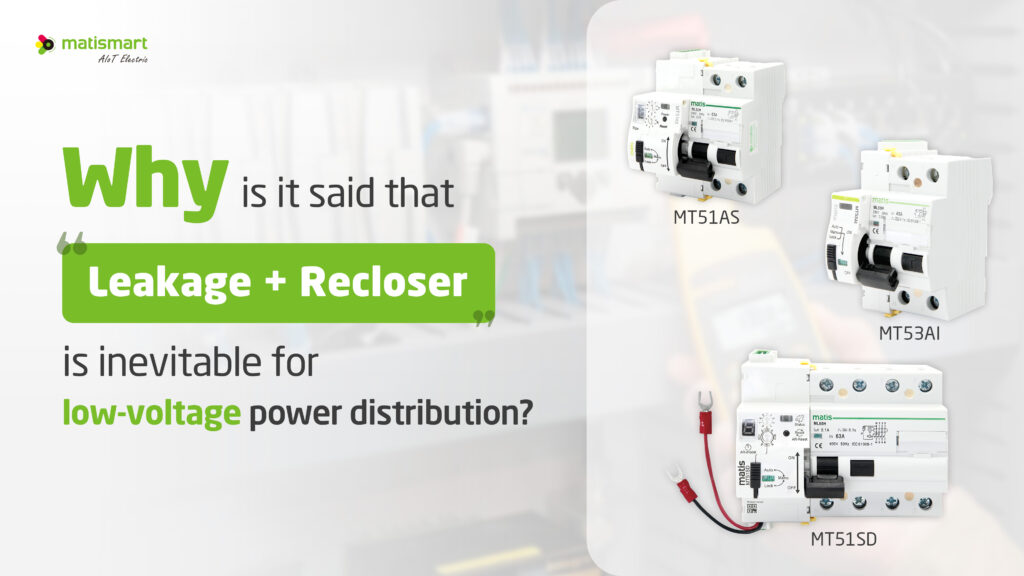
🔹 04 | MT51SD — Smart Automatic Recloser with Insulation Check
This is Matismart's most complete and arguably most complex solution currently available. I can say responsibly that it covers all scenarios.
Core Features:
- Insulation check before closing (similar to the Gewiss Restart approach).
- IO control (for linking with fire alarms, PLCs, BMS), multi-mode design comparable to Schneider iC60.
- RS485 control.
- SREC retry sequence with over 10 built-in options and customization capability.
It targets sectors with extremely high safety requirements:
- Medical
- Data centers
- Telecommunications
- High-end commercial buildings
- Engineering EPC projects
- Overseas markets
Simply put, this product is not designed for "general needs" but for scenarios that truly demand "must not stop, and must not stop incorrectly."

🟦 Our Perspective Comes from Global Insight, Our Products Grow from the Field
We dare not claim to be the strongest in the industry, but we can honestly say: Matismart's understanding of automatic reclose no longer stays at the level of "it can close automatically." We have:
- Seriously studied the solutions from Gewiss, Circutor, Schneider, and Legrand.
- Listened to complaints from base station users.
- Researched the logical boundaries of IEC 61008 / 63024.
- Seen countless site incidents where a single "trip" caused hundreds of thousands in losses.
- Also witnessed the even more terrible consequences caused by "blindly closing."
It is these experiences that make us more humble and more respectful of this matter. We aim to prevent the "low-voltage system from shutting down due to a momentary fault." This work is valuable, and we will continue to do it.