


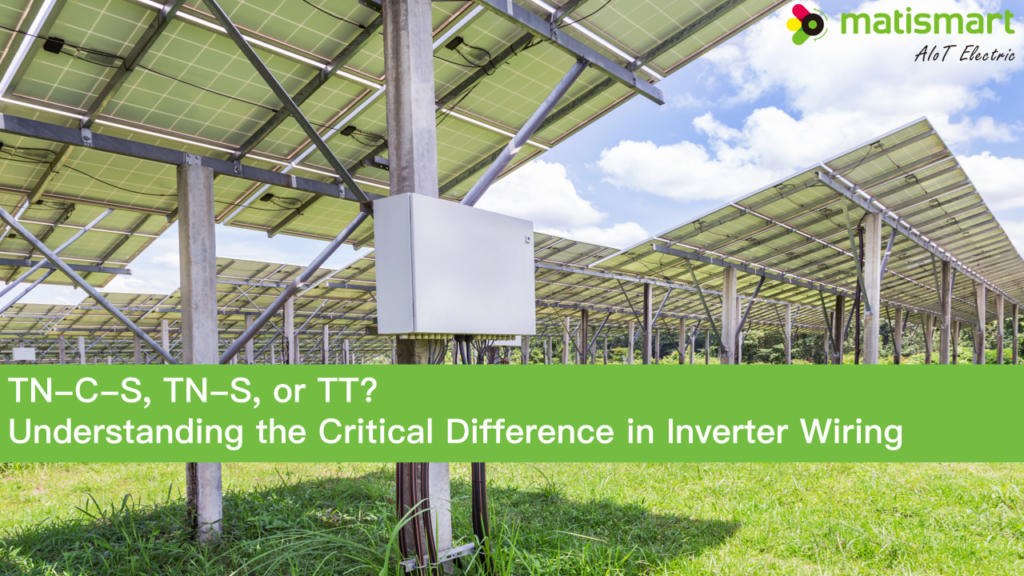
Recently, while advancing various PV (photovoltaic) projects, we encountered a puzzling issue: the same inverter model appears to have fundamentally different earthing (grounding) and main circuit wiring depending on the country. Specifically, the path of the protective earth (PE) and neutral (N) conductors varies wildly, and some main circuits utilize Residual Current Devices (RCDs) while others do not.


Why is this the case?
The answer is that these seemingly "minor differences" are actually the result of major underlying differences in national electrical distribution system philosophies.
We are pleased to share a purely technical, industry-focused breakdown of this topic, with special thanks to Matismart CTO, Wynn Zhang, for his invaluable support.
In this article, we aim to clarify a few questions that are often considered "old news" but are critical for safe and compliant PV design:
- Why do electrical system designs differ so much across countries?
- Why is Australia frequently cited as an example where an RCD is sometimes not required?
The starting point for everything—as dry as it may seem—is the IEC Standard.
→ IEC Standard Definitions of Earthing Systems
In IEC 60364-1 (GB/T 16895.1-2008), the standard defines the naming conventions for all low-voltage systems worldwide: TN, TT, and IT.
The first letter indicates the relationship between the power source side and the earth: T: Direct connection to earth (Terre) I: Isolated from earth or connected through an impedance (Isolated)
The second letter indicates the relationship between the equipment casing and the earth: T: Independent connection to earth N: Connected to the power source's neutral point
Additional Letters (C / S): C: N and PE combined (PEN conductor) S: N and PE separated
In practice, the TN system has three subtypes: TN-C, TN-S, and TN-C-S, which differ in the way the N and PE earthing conductors are connected. This results in the five systems we are familiar with:

TN-S System
In the TN-S system, the protective earth (PE) conductor and the neutral (N) conductor run separately from the power source to the end user, without interference.
The metal casing of all equipment is connected to this independent PE conductor or the main earthing terminal. This ensures that in the event of an insulation fault or ground fault, the fault current immediately follows the safe path back to the source via the earth wire, rather than passing through a person and creating a risk of electric shock.
👉 In Summary: The neutral conductor runs its own path, the protective earth runs the safety path, and they do not mix. It is stable, clean, and considered the safest type within the TN system.

TN-C Earthing System
In the TN-C system, the neutral conductor (N) and the protective earth conductor (PE), which should normally be separate, are combined into a single conductor.
This conductor is called the PEN conductor.
It is responsible for completing the circuit for normal operating current and for safely returning fault current to the source during a ground fault. The metal casings of all equipment are connected to this single conductor.
The advantage of this approach is saving wire, reducing cost, and simplifying construction.
However, the disadvantages are equally clear: if the PEN conductor is broken or has a poor connection, the equipment casing can become live, potentially causing electromagnetic interference, or even leading to a fire.
👉 In Summary: One wire does two jobs, acting as both neutral and earth. It saves costs but sacrifices safety.

TN-C-S Earthing System
In the TN-C-S system (also known as the MEN System), the first segment of the circuit uses a single combined conductor for the neutral (N) and protective earth (PE) functions. This is the PEN conductor.
It is only at the consumer's distribution board that the PEN conductor is separated into independent N and PE conductors, connected via a copper bar (a metallic link), which is often referred to as the MEN Link.
To enhance safety, the PEN conductor is earthed multiple times along its route (e.g., at poles, transformers, and the service entry point). The customer's installation will also include an additional earthing rod, connecting all equipment casings via the PE conductor to this point, forming the main earthing terminal.
👉 In Summary: The first segment uses "one wire for two jobs," but upon reaching the consumer's premises, the roles are "clearly separated," ensuring both continuous power supply and safe earthing.


TT Earthing System
In the TT system, the power source end (the transformer) has its own earthing, and the metal casings of equipment at the customer's premises must also be separately connected to an independent earthing electrode. These two earths are not interconnected and operate independently.
In the case of overhead power distribution, fault current flows from the equipment casing into the soil, and then travels through the earth back to the power source's earthing point.
Because the resistance of the ground is relatively high, resulting in high loop impedance, the neutral (N) and protective earth (PE) conductors must never be combined in a TT system. The power company is only responsible for supplying the L and N conductors; the customer must install their own earthing rod and maintain the earthing system themselves.
👉 In Summary: The TT system is "You have your earth, and I have mine," operating independently, with safety guarded by RCDs (Residual Current Devices).

IT Earthing System
In the IT system, the power source side is virtually isolated from the earth—it is either completely floating or only lightly earthed through a high-impedance component (a resistor or inductor).
Its most significant feature is that even if one phase (e.g., L1) accidentally contacts the earth, the system will not trip immediately and can continue operating. This situation is called the "First Earth Fault."
While it sounds hazardous, this system is custom-designed for critical locations:
For example, hospital operating rooms, mines, and power plant control systems—these places fear sudden power loss more than a temporary fault. When the first fault occurs, the system triggers an alarm to notify personnel but does not immediately cut power, giving maintenance staff time to locate and resolve the issue.
👉 In Summary: The IT system prioritizes alarms over tripping; power continuity is prioritized over immediate disconnection to prevent harm. It relies on high impedance to "limit" the fault current, stabilizing the system and ensuring a continuous power supply.
Schematic Diagram of an IT System with Independent ECP Earthing

Schematic Diagram of an IT System with Collective ECP Earthing

Comparison of Low-Voltage Earthing Systems

→ Summary Comparison of Low-Voltage Earthing Systems
We have been discussing how inverters are wired according to the three most common global low-voltage earthing systems.
🇦🇺 TN-C-S (MEN System)—Protection by "Brute Force"
The system in Australia and New Zealand is highly distinctive.
The grid does not supply three conductors (L, N, PE), but rather L + PEN. The PEN conductor is only separated into N and PE at the customer's main distribution board, where they are short-circuited by a copper link—this is the MEN Link.
This link is the soul of the system.
If a fault occurs and the equipment casing leaks current, the current does not pass through the soil but instead travels directly back to the transformer via the copper wire. The impedance is extremely low, let's assume only 1Ω:I = 230V ÷ 1Ω = 230A
A current of 230A is enough to cause the circuit breaker (MCB) to trip in less than 0.02s. Therefore, many branch circuits in Australia do not require RCDs.
💪 The MEN system relies on "brute force" for safety.


In the TN-C-S System (MEN):
From the transformer all the way to the customer, the PEN conductor is earthed at multiple points along the way, essentially creating a "copper busbar connected to a string of earthing rods." The entire circuit is almost entirely composed of metallic conductors, resulting in extremely low impedance (approx. 1 Ω). During a fault, the current easily reaches hundreds of amperes, allowing the MCB to trip the power reliably on its own.
🇩🇪 TN-S System—Protection by "ΔI Detection"
Countries like Germany, China, and Japan adopt the TN-S system.
From the transformer source, N and PE are completely separated and remain independent throughout the entire path.
The longer path and greater number of connections result in higher impedance (approx. 10Ω): I = 230V ÷ 10Ω = 23A.
Since the current is not large enough, the MCB may not trip in time. Therefore, they introduced the RCD (Residual Current Device).
The RCD does not care about the magnitude of the current; it only checks for "balance": whatever current goes in via L must come out via N. If they are unequal, it trips.
The TN-S system does not rely on "large current" but on ΔI detection to "judge correctness" and disconnect the power.


In the TN-S system, N and PE run separately. The PE line passes through multiple nodes and connections, resulting in a longer path and many contact points, leading to medium impedance (approximately 5~20Ω).
The fault current is not large enough, so tripping relies on the RCD (Residual Current Device) detecting current imbalance.
🇫🇷 TT System — Protection by "Sensitivity"
The TT system in countries like France, Spain, and Belgium is the most "independent."
The grid only supplies L and N; the user must install their own earthing rod to form an independent PE.
Assuming the earth resistance is 50Ω:I = 230V ÷ 50Ω = 4.6A
A current of a few amperes will not cause the MCB to trip at all.
Therefore, the TT system must use a high-sensitivity RCD (30 mA/30 ms).
The TT system relies on "sensitivity for safety."


TT System
In the TT system, the power source and the user each establish their own earthing electrode, and part of the fault loop path must pass through the soil.
Soil resistance can easily range from tens to even hundreds of Ohms, resulting in the highest impedance (approximately 50~200Ω).
The fault current is only a few Amperes, meaning the MCB (Miniature Circuit Breaker) will not trip at all. Power disconnection must rely on a high-sensitivity RCD (Residual Current Device).
Same Fault, Different Outcomes (Numerical Comparison)

Conclusion: The True Meaning of Earthing
Regardless of whether it is a TN-C, TN-S, TN-C-S, TT, or IT system, their single ultimate goal is to provide a safe "return path home" for the current when a fault occurs.
During normal operation, current flows along the working circuit (L → N). However, when the equipment insulation fails and the casing becomes live, the fault current must quickly return to the power source's neutral point along the protective circuit (PE). This ensures that the protective device (MCB, RCD) trips immediately, cutting off the power to prevent electric shock and fire.
This is why—
The working neutral conductor (N) and the protective earth conductor (PE) must be distinguished;
They cannot be mixed or substituted for one another. Mixing them can lead to serious consequences such as energized casings, voltage drift, and false RCD tripping.
Therefore, the essence of an earthing system is not to "dump current into the earth," but rather to provide a safe, low-impedance, and controllable return path for fault currents.
→ Q&A:
Q: Is it true that the MEN grid system has "only one wire coming in, then separating in the box," which results in lower resistance?
A: Yes. The PEN conductor is combined → separated into N/PE at the user's MEN Link. The copper wire forms a very short, closed fault loop, leading to a large fault current, and thus faster tripping by the MCB. Simultaneously, the PEN conductor has repeated earthing (Multiple Earthed Neutral) to lower the overall loop impedance, further ensuring the reliability of the "hard trip."
Q: Since TN-S also uses copper wire, why the strong emphasis on RCDs?
A: The PE path in TN-S is longer and has more connection points (source → feeder → floor → panel → branch → equipment). The actual loop impedance is often significantly higher than the short, closed loop of the MEN system. The RCD does not depend on the current's magnitude; it uses Delta I detection to trip selectively and quickly once the threshold is reached. This makes it more controllable and favorable for EMC (Electromagnetic Compatibility).
Q: Given the wide variations in earth resistance in TT systems, are they reliable?
A: Their reliability depends on high-sensitivity RCDs. The key to the TT design lies in the earthing electrode and the soil (equipotential bonding, resistance reduction, and layout). Reliability is further ensured through graded RCDs, selective settings, and periodic inspection to guarantee "fast disconnection without isolating large areas."
→Standards Reference (IEC / GB Corresponding Relationship)

Understanding these fundamental earthing principles is non-negotiable for safe and compliant PV system design. Did this breakdown help clarify the critical differences between protection by 'Brute Force' (TN-C-S/MEN), Delta I Detection' (TN-S), and 'Sensitivity' (TT)?
We want to hear from you. Which earthing system presents the biggest challenge in your current international projects, and why?