


As electrical infrastructures become more complex, dense, and data-driven, the limitations of traditional power monitoring architectures are becoming increasingly visible. Industrial operators, EPCs, and system integrators are all facing the same pressures: limited cabinet space, rising labor costs, stricter uptime requirements, and the need for scalable monitoring as energy management becomes a strategic priority.
At Matismart, we have spent years working on multi-circuit monitoring projects across factories, utilities, and critical facilities. The conclusion is clear: the industry needs a new approach.
Enertrek was developed precisely for this shift. Below is a practical look at why traditional solutions struggle—and how a modern, modular architecture can fundamentally improve efficiency and scalability.
📦 Space: The First Bottleneck in Dense Distribution Panels
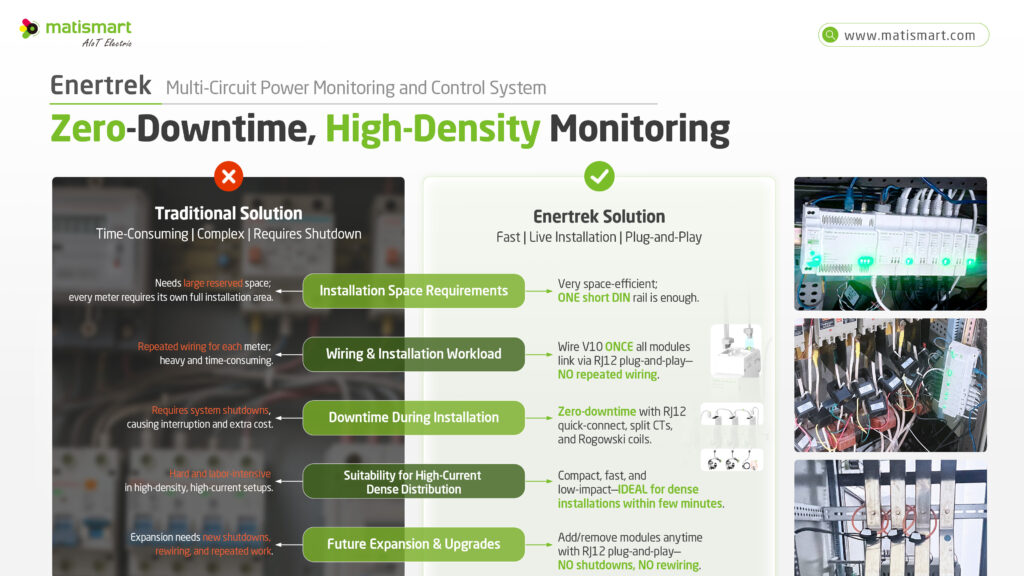
Traditional meters require dedicated installation space for each unit. In high-circuit or retrofit projects, this becomes a physical bottleneck that forces engineers to redesign panels or sacrifice monitoring coverage.
Enertrek removes space as a constraint. A compact module chain on a short DIN rail can replace an entire row of individual meters. This opens the door for multi-circuit monitoring even in highly crowded industrial panels.
For facilities expanding fast or planning future energy digitalization, this difference alone can reshape feasibility.

🔌 The Hidden Cost: Repetitive Wiring and Installation
Installing a traditional system means wiring every meter independently again and again. For 10, 30, or 50 circuits, the workload grows exponentially.
With Enertrek, voltage wiring is done once through the V10 module.
All other modules simply plug in via RJ12.
This removes hours (or days) of redundant installation work and significantly reduces the chance of wiring errors. For integrators facing tight project timelines, this is a real operational advantage—not just a technical feature.

⏱️ Zero-Downtime Installation Is Becoming a Business Requirement
In many industries, shutting down power is not an option. Yet traditional solutions require exactly that for installation, upgrades, and expansion.
Enertrek enables true zero-downtime installation using:
- RJ12 quick-connect wiring
- Open split-core CTs
- Rogowski coils
This means multi-circuit monitoring can be added without interrupting production, which directly protects operational continuity and reduces risk for facility owners.

⚡High-Current and High-Density Sites Need a Different Architecture
Factories, data centers, and heavy-load facilities often need dozens of circuits monitored in limited cabinet space. Traditional meters struggle in these environments due to bulk, wiring effort, and heat accumulation.
Enertrek’s lightweight, compact, and modular design is inherently suited for these environments. In many high-density projects, it is not just better—it's the only practical way to implement multi-circuit monitoring without redesigning the entire power cabinet.

🔄 Scalability: A System That Grows With You
The energy landscape is changing quickly. New loads, new machines, and new monitoring requirements appear every year. Traditional solutions handle expansion poorly:
- New shutdowns
- New wiring
- New engineering time
- New risks
Enertrek is designed for continuous evolution. New modules can be added or removed at any time, using the same RJ12 plug-and-play architecture—no rewiring, no downtime, no reconfiguration.
This makes the system genuinely future-proof and keeps the total cost of ownership low over the entire lifecycle.


Conclusion: A Modern Architecture for a Modern Industry
The move toward digital, efficient, high-density electrical infrastructures requires more than incremental improvements. It requires a new architecture—one that is compact, installation-friendly, non-intrusive, and scalable.
Enertrek represents this new direction.
For facility owners, engineers, EPCs, and integrators seeking to modernize their power monitoring approach, Enertrek offers a streamlined and future-ready foundation that aligns with the realities of today’s electrical environments.

If you’re exploring ways to modernize your power monitoring infrastructure—or if you’re evaluating alternatives to traditional multi-meter installations—our team would be happy to share reference projects and practical insights from real deployments.
Feel free to reach out or leave a comment.
Let’s build a smarter, safer, and more scalable electrical architecture together.